
The #1 Nuclear State in America Can't Figure Out How to Sell Power to Data Centers

A research brief on the collision between AI infrastructure ambition, grid constraints, and regulatory paralysis in the nation’s #1 nuclear state
Illinois ranks fourth in the U.S. by number of data centers — more than 220 sites (estimates range from 222 to 244 depending on the source), concentrated in and around Chicago. The state generates more nuclear power than any other, operates top-tier fiber routes, and sits on flat, buildable land with access to Great Lakes water. On paper, it should be one of the best data center markets in America.
Instead, it’s becoming one of the most contested.
In the past 90 days, at least six Illinois communities have imposed moratoriums, rejected proposals, or held packed public meetings opposing data center development. The governor has reversed course on tax incentives he signed into law in 2019. A sweeping regulatory bill — the POWER Act — is working through committee. And behind all of it sits a basic, unresolved problem: the grid cannot support what’s being proposed.
This brief maps the full picture — the projects, the grid math, the regulatory landscape, and the community dynamics — for anyone trying to understand what’s actually happening in Illinois.
The Grid Math
A December 2025 state resource adequacy study projects power shortfalls beginning in the Commonwealth Edison (ComEd) service territory in northern Illinois by 2029, and in Ameren’s downstate territory by 2031.
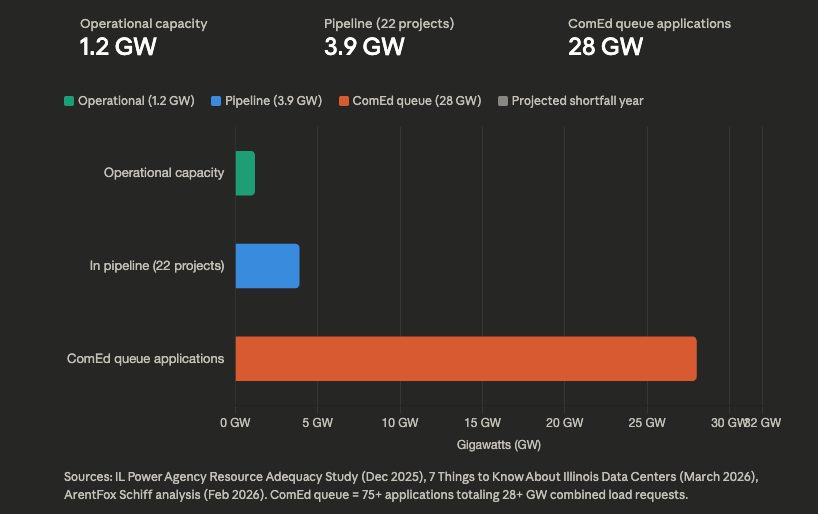
The numbers behind those shortfalls:
Illinois data centers currently operate roughly 1,200 MW of capacity, consuming approximately 12 TWh/year — enough to power 1.1 million homes.
An additional ~3,900 MW of new capacity is in the planning pipeline across 22 proposed projects.
ComEd has received over 75 data center interconnection applications totaling more than 28 GW of combined load.
AI development alone is expected to drive power demand in the Chicago area up by as much as 900%.
The Union of Concerned Scientists estimates data centers could account for 64–72% of energy demand growth in Illinois by 2030.
Projected system costs tied to data center growth: $24–37 billion through 2050.
The impact on consumers is already measurable. The capacity portion of a typical ComEd residential bill jumped from roughly $0.91/month in mid-2024 to approximately $8.00/month by mid-2025 — an increase exceeding 775%. Statewide, electricity costs rose about 15% between 2024 and 2025, compared to a national average of 4.5%. The Citizens Utility Board estimates Chicago-area electric bills could rise another $70 within three years, driven primarily by data center demand.
Adding pressure: the PJM interconnection queue — the pipeline through which new generation connects to the northern Illinois grid — has been frozen since late 2025 due to a backlog exceeding 200 GW, and won’t reopen until April 2026. Ameren, which serves downstate, has over 1,700 projects waiting in its own queue and won’t fully transition to concurrent (parallel) application review until January 2027.
Meanwhile, planned retirements of coal, gas, and oil generators across both PJM and MISO territories are shrinking available supply at precisely the moment demand is surging.
The Projects: What’s Proposed and Where
Joliet Technology Center — $20 billion, 1.8 GW
The largest proposal in the state. Developer Hillwood (a Perot family company) and PowerHouse Data Centers are proposing a 795-acre campus south of the Chicagoland Speedway with 24 two-story buildings across four phases. The Plan Commission voted 7-1 to recommend approval on March 5. The City Council held a marathon public hearing on March 16 — over six hours of testimony, with hundreds of residents in packed overflow rooms, the majority opposed. The hearing ran past midnight, and because March 17 was Election Day (Illinois law bars public bodies from meeting on election days), the vote was postponed to Thursday, March 19. One resident presented nearly 5,000 petition signatures against the project.
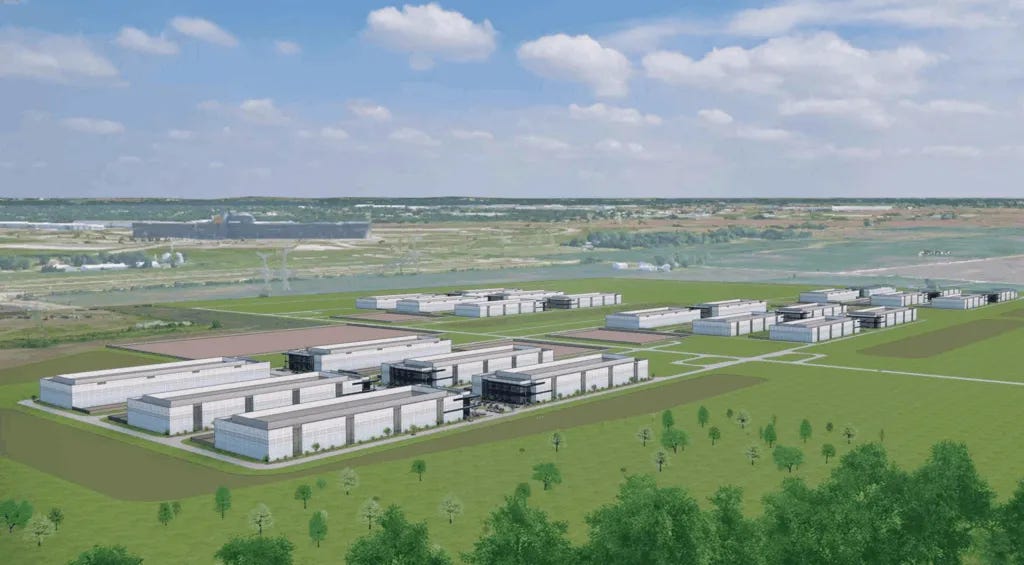
Rendering of the Joliet Technology Center campusCredit: Courtesy Hillwood, PowerHouse Data Centers
The Joliet City Council approved the project 8-1 on March 19. Dozens of union workers filled the council chambers ahead of the vote, creating tensions with residents who complained about being shut out of the room. PowerHouse Data Centers said the companies will secure and pay for their own energy consumption through ComEd to avoid costs being passed onto local customers. Groundbreaking is expected in late summer to early fall 2026.
The developer has pledged $100 million in direct community payments ($20 million upon closing, $20 million per phase), plus an estimated $310 million in property taxes and $40 million in utility taxes over 30 years — with no tax abatements. Supporters, primarily building trades unions, cite 7,000–10,000 construction jobs and 700 permanent positions (paying $125,000+). Developer consultants said both ComEd and PJM reviewed the plan and determined the grid can support the added demand. Opponents point to the site’s location above a depleted aquifer, as Joliet transitions to Lake Michigan water via a new pipeline — a $1.44 billion project intended to serve 300,000 people, not cool data centers, as a spokesperson for State Sen. Rachel Ventura noted.
CyrusOne Springfield (Sangamon County) — 634 MW hyperscale
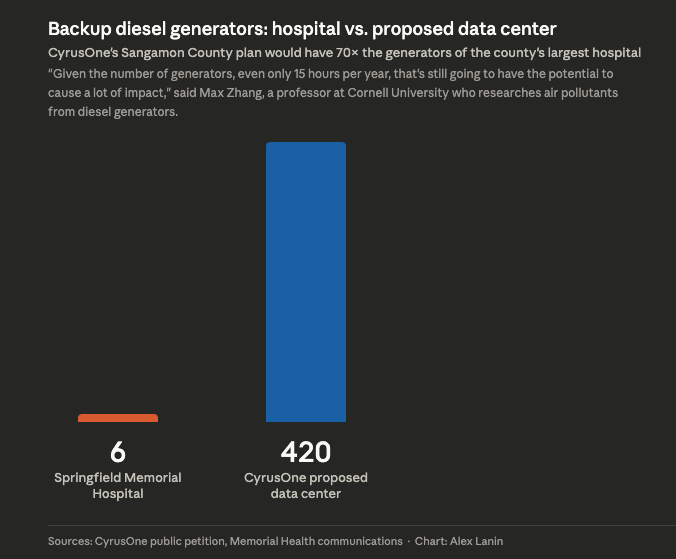
CyrusOne is proposing a 280-acre data center campus that would be the largest in the company’s portfolio — roughly six times the size of its existing Aurora facility (109 MW). The plan includes 420 diesel backup generators, which Cornell University professor Max Zhang, who researches air pollutants from diesel generators, called the largest number he’s heard of for a single data center. The county’s environmental review was minimal: only a state historic preservation check and a natural resources screen (no endangered species found, no ecological assessment conducted). CyrusOne has already received $132.5 million in tax breaks for its Aurora site through the state’s Data Center Investment Program. The Sangamon County Board is scheduled to vote March 23.
Edwardsville / Madison County — Cloverleaf Infrastructure
Cloverleaf Infrastructure (Houston/Seattle, backed by $300 million in PE funding) has been in discussions with Edwardsville city and Madison County officials for nearly a year — exchanging detailed emails about site selection, special-use permits, and land surveys. Yet the city’s official Facebook post on February 10 stated it had received “no formal proposal.” Mayor Art Risavy told a reporter he was unaware of any talks. The city draws a distinction between a “conceptual site plan” (which Cloverleaf has submitted) and a “formal proposal.” Cloverleaf says it’s awaiting information from Ameren on electrical connection points. Cloverleaf co-founder Brian Janous, a former Microsoft executive, previously stated the company would never build next to a neighborhood — but proposed exactly that in nearby Troy.
Troy — rejected by community
Cloverleaf proposed two sites near residential neighborhoods in Troy. Dozens of residents spoke against the project at two February public meetings. Madison County Board Chairman Chris Slusser subsequently proposed redirecting development to an industrial corridor along Route 3, effectively signaling the Troy sites are incompatible.
Granite City
The city’s plan commission postponed a data center zoning change on February 5. Mayor Mike Parkinson says there’s no formal offer but acknowledged the city has been discussing zoning and potential sites with Cloverleaf — similar to Edwardsville. Parkinson cited the city’s industrial history and pledged to regulate properly.
HydraVault — Chicago South Loop
A small-scale data center converting from a planned esports arena at South Wabash and East 25th Street. The switch from arena to data center was classified as a “minor change” by Chicago zoning officials — requiring no public hearing. Some neighbors learned about the project from roommates, not from the developer. HydraVault claims a closed-loop cooling system and “sustainable by design” operations. Groundbreaking has occurred; early user access is expected by December 2026.
Active Moratoriums
Beyond these specific projects, several communities have hit pause. Aurora’s 180-day moratorium expires around March 24 — the city has multiple existing data centers with several more in development and has drafted new ordinances requiring sound studies, water consumption reports, energy usage reports, and on-site renewables or storage. Godfrey passed a six-month moratorium on January 20. Collinsville imposed a one-year moratorium in late 2025.
The Regulatory Landscape
POWER Act (SB 4016 / HB 5513)
The most significant piece of proposed data center legislation in Illinois, introduced in February by Sen. Ram Villivalam (D-Chicago) and backed by the Illinois Clean Jobs Coalition.
The bill’s central mechanism is what supporters call BYONCCE — Bring Your Own New Clean Capacity and Energy. It requires data centers to pay for their own energy and the infrastructure to generate it, and mandates that energy come from renewable sources. Data centers that secure 80% of their power from new clean energy by 2030 and 100% by 2045 receive fast-track grid interconnection — the single thing developers want most. Those that don’t build clean energy wait in the general queue and face electricity curtailment during peak demand. Data centers must also pay for grid upgrades — transmission lines, substations — needed to serve them.
On the consumer side, the bill prohibits shifting data center energy costs to ratepayers and creates a Public Benefits and Affordability Fund. Each data center would contribute annually based on peak demand, with funds directed to utility-bill assistance (LIHEAP), shutoff avoidance, whole-home retrofit programs, and environmental justice initiatives.
The community provisions are equally aggressive. The bill requires IEPA community impact assessments, mandates community benefits agreements enforced by a coalition of residents, organizations, and local officials, and demands water-use transparency with IEPA permits for wastewater. It prohibits NDAs between data center developers and local governments. All of this applies to hyperscale facilities exceeding 50 MW of peak demand.
Status: In committee — House Executive Committee and Senate AI and Social Media Subcommittee. The legislative session runs through May 31, but Illinois has a history of passing large energy packages as late-session amendments.
Industry response: The Data Center Coalition and Illinois Manufacturers’ Association have pushed back — IMA called it “penalizing innovation.” But House Majority Leader Robyn Gabel (D-Evanston) says both groups indicate much of the bill is workable and are open to negotiation.
Pritzker’s Tax Incentive Pause
Governor JB Pritzker proposed a two-year moratorium on state tax incentives for new data centers, effective July 1, 2026. Since 2019, Illinois has provided $983 million in estimated lifetime tax breaks to at least 27 data centers. Pritzker, who originally signed the incentive legislation, has reversed course amid grid strain and community backlash.
Clean and Reliable Grid Affordability Act (2025)
Passed in the fall 2025 veto session. Added new air regulations for backup generators used by data centers, expanded energy efficiency programs, and eased battery storage deployment.
Nuclear Expansion
Illinois removed the moratorium on small nuclear generation projects starting January 1, 2026 (H.B. 2473). A federal bill (S.B. 1527) would lift remaining restrictions on new large reactors. Illinois already generates more nuclear power than any other state — 11 reactors across six plants produce roughly 54% of all power in the state.
Federal-Level Dynamics
The federal picture is moving too, though unevenly. In January, Pritzker joined the Trump administration and 12 other governors in the PJM service area to call on PJM to allocate new capacity costs to data centers. In early March, seven tech companies — Google, Amazon, Microsoft, Meta, and others — signed a voluntary, nonbinding “Ratepayer Protection Pledge” at the White House, agreeing to cover the majority of data center energy costs, though the pledge includes no penalties or enforcement.
On the legislative side, Sen. Tom Cotton’s DATA Act would exempt off-grid power suppliers from the Federal Power Act and DOE regulations, potentially allowing data centers to build captive generation faster. FERC is separately examining how to regulate data center co-location with power plants and has directed PJM to address consumer protection.
Illinois also faces a unique friction point in its 2008 Biometric Information Privacy Act (BIPA). Brad Tietz, state policy director for the Data Center Coalition, says legal liabilities under BIPA are driving operators to other states. Reforms in 2024 reduced exposure, but the industry says it’s not enough.
ComEd Revenue Guarantee
ComEd announced it will require a 10-year guarantee of revenues upfront from large energy consumers — intended to prevent ratepayers from bearing costs of data center projects that are proposed but never completed. Sen. Bill Cunningham (D-Chicago) warned that “speculation about data center development has actually increased prices” — not just immediate demand, but anticipated future demand. Consumer advocates at the Citizens Utility Board have called these speculative proposals “phantom data centers” that inflate capacity prices without ever materializing.
Community Opposition: The Common Threads
Across every contested project, the same concerns recur:
Rising electricity bills — the single most powerful issue. Residents connect data center growth directly to rate increases they’re already experiencing.
Water consumption — data centers use between 18,000 and 550,000 gallons per day depending on facility size. Fewer than a third of U.S. data centers track their water use. In DeKalb, the Meta data center is projected to push the area into a water deficit by 2030. In Joliet, the site sits above an aquifer that’s been depleted after a century of pumping.
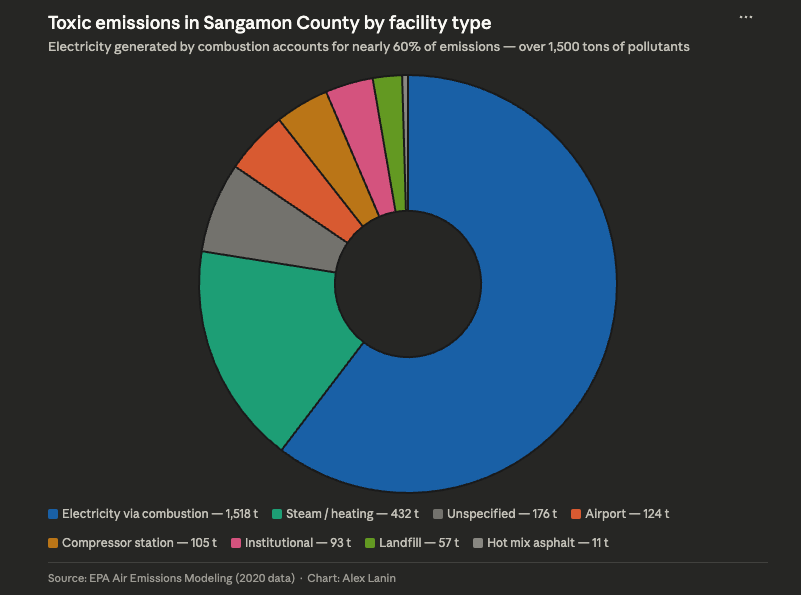
Air quality and diesel generators — backup generators at data center scale produce emissions comparable to the most polluting combustion turbines. CyrusOne’s 420-generator plan in Springfield has no stringent emissions controls because generators classified as “emergency use” face minimal regulation — a gap the Trump administration is not closing.
Transparency — NDAs, “minor change” zoning workarounds, and city officials posting “no formal proposal” while exchanging months of detailed emails with developers. The industry’s own professionals acknowledge this is a problem.
Permanent employment — data centers create significant construction jobs (4,000–8,000 across 27 active Illinois projects) but relatively few permanent positions. Between 2019 and 2024, 27 facilities added 534 full-time operations jobs statewide — an average of about 20 per facility.
Tax incentive imbalance — $983 million in tax breaks since 2019, while the state’s 2023 data show the industry generated $1.85 billion in total fiscal support (much of it property taxes). But incentives delay and dilute those returns, and the Data Center Investment Program already gave CyrusOne $132.5 million for its Aurora site alone — more than the company would pay in property taxes to Sangamon County over 20 years for the Springfield project.
The Economic Case
Supporters — primarily building trades unions, chambers of commerce, and development-oriented officials — make a straightforward argument: Illinois needs the money, and these projects deliver it at scale.
The construction employment alone is substantial. The Joliet project promises 7,000–10,000 jobs; across the state’s 27 active projects, estimates range from 4,000 to 8,000 construction positions. Illinois homeowners pay the nation’s highest effective property tax rate at 1.83%, and data centers spread that burden across more payers. The predictable, round-the-clock nature of data center load also creates revenue stability for utilities and electric co-ops — co-ops already serve nearly 300 data centers nationally, with 150 more under construction, and rural areas offer cheap land, tax incentives, and reliable power.
There’s also the infrastructure argument. Data center builds bring fiber, broadband, and grid modernization that benefit broader communities. And strategically, Illinois’ nuclear fleet, fiber density, skilled workforce, and climate make it naturally competitive for these investments. But the Data Center Coalition warns the state is losing ground to Pennsylvania, Georgia, Texas, Wisconsin, and Indiana — states with friendlier regulatory environments and fewer legal friction points.
What’s at Stake
The core tension in Illinois is not unique, but it’s especially acute. The state has natural advantages that most competitors lack — above all, its nuclear fleet and Great Lakes water access. It also has a regulatory environment, a biometric privacy law, and a rising tide of community opposition that are collectively slowing development to a crawl.
The POWER Act’s BYONCCE model — offering fast-track interconnection to data centers that bring their own clean energy — is being watched nationally as a potential template. But the bill remains in committee, the legislature adjourns May 31, and the gap between what’s proposed and what the grid can deliver is widening every quarter.
Critically, because Illinois sits within the PJM territory, data centers built in neighboring states still impact what Illinois ratepayers pay. As House Majority Leader Gabel put it, the state feels a responsibility to put guardrails in place — but inaction doesn’t eliminate the cost; it just means Illinois bears the price of other states’ data centers without capturing any of the economic benefit.
The next 90 days — with Joliet’s approval now locked in, the Sangamon County vote on March 23, Aurora’s moratorium expiring March 24, and the POWER Act’s legislative window closing May 31 — will determine whether Illinois establishes a coherent framework or continues project-by-project.
Sources: Illinois Answers Project, Capitol News Illinois, Medill Illinois News Bureau, DePaul CJIE / NBC Chicago, Citizens Utility Board, Union of Concerned Scientists, ArentFox Schiff, Canary Media, NRDC, Inside Climate News, Illinois Power Agency Resource Adequacy Study (Dec. 2025), ABC7 Chicago, Shaw Local, WGN, CBS Chicago, NRECA.
Well done, Alex.